Your Products Are Selling Inside ChatGPT. Is Your Shopify Catalog Ready?
AI-referred shoppers now convert at a higher rate than traditional organic and paid traffic on Shopify stores, and brands using Shopify's Agentic Storefronts are seeing measurable revenue from AI channels within weeks. The brands pulling ahead aren't running new ad strategies; they're feeding AI assistants clean, structured, consistent product data.
Why AI Discovery Is No Longer a Future-Tense Conversation
For the last year, "AI shopping" has mostly been a slide in a trends deck. Something brands nodded at, filed under emerging, and revisited later. That window just closed. Shopify's Agentic Storefronts are live, and the early revenue numbers are public. According to Shopify's Spring '26 Edition release, red light therapy brand Omnilux saw AI channels drive 3.2% of total revenue in March, and luxury bedding brand Cozy Earth reported AI channel revenue up 20x year over year. Separately, new data shows AI-referred shoppers, people landing on a Shopify store after asking ChatGPT, Perplexity, or Google AI Mode for a recommendation, are converting at a higher rate than traditional organic and paid traffic. That's not a projection. That's published, attributed revenue, sitting next to traffic that converts better than the channels most brands have spent years optimizing. The question for DTC brands isn't "is this real" anymore. It's "why isn't this our traffic yet."
What's Actually Happening Under the Hood
What is a Shopify Agentic Storefront, exactly? AI assistants don't browse a website the way a person does. When someone asks ChatGPT or Perplexity for a product recommendation, the assistant is pulling from structured product data: titles, descriptions, attributes, pricing, availability, sometimes reviews. It's reading the catalog, not the homepage. That's the basic mechanic behind agentic commerce, and it's exactly what Shopify's Agentic Storefronts are built to support: native infrastructure that gives AI assistants structured access to a brand's catalog, enabling more accurate recommendations and, in some cases, in-assistant checkout. Shopify's Agentic Storefronts formalize this. They give AI agents structured access to a brand's product catalog so it can be surfaced accurately in AI-generated answers, and in some cases, completed as a transaction directly inside the AI interface. That gap, scraped versus structured, is the entire game right now. Two brands can sell the same product. The one with clean, consistent, well-tagged product data is the one the AI recommends with confidence. The one with thin descriptions and inconsistent attributes either gets recommended inaccurately or doesn't get recommended at all. It's the same fundamental discipline behind traditional SEO, just applied to a new kind of reader.
The Diagnostic: Is Your Catalog AI-Ready?
Before investing in anything new, most brands need to answer a more basic question: would an AI assistant actually be able to describe your product correctly right now? A few signals that the answer is no.
• Product titles are packed with keywords, but don’t plainly explain what the product is, who it’s for, or why it matter.
• Descriptions differ across your DTC site, Amazon listing, and Instacart or retail syndication. Each channel was updated separately, by a different person, at a different time.
• Attributes like size, material, scent family, or skin type live in unstructured paragraph copy instead of structured fields.
• Variant data is incomplete or inconsistent, so an AI pulling from the feed has to guess.
• Reviews and ratings aren't connected to the product feed in a way that's machine-readable.
If two or more of those are true, an AI assistant is currently working with a degraded or contradictory version of your catalog, not skipping the brand entirely, but actively misrepresenting it, which erodes trust with exactly the high-intent buyer the channel is best at delivering. That's not a future risk. It's actively costing you visibility in recommendations happening right now. And the upside for fixing it is real: do AI-referred shoppers actually convert better? Early data confirms it: AI-referred traffic on Shopify stores is converting at a higher rate than traditional organic and paid traffic, and agentic conversions specifically are converting at roughly double the rate of traffic from scraped, unstructured catalog data.
What Brands Should Actually Do This Quarter
So what's the fastest way to improve AI discovery for your products? It doesn't require a platform migration or a new tech stack. It requires treating the product catalog as the primary marketing surface it's quietly become, starting with a straightforward audit.
1. Audit catalog consistency across every channel. DTC site, Amazon, Instacart, retail syndication. Titles, descriptions, and attributes should describe the same product the same way everywhere.
2. Move key attributes out of paragraph copy and into structured fields. Size, material, scent, skin type, dietary information, whatever defines the product in your category. Structured data is what AI systems can actually parse with confidence.
3. Treat product titles as clear product descriptions, not just SEO assets. A title should immediately communicate what the product is in a language both shoppers and AI assistants can understand. The best product titles combine clarity with strategic keyword optimization, making them easier for search engines to index and AI systems to interpret accurately.
4. Connect reviews and ratings to the feed in a machine-readable way. Social proof is part of how AI assistants build confidence in a recommendation.
5. Evaluate Shopify's Agentic Storefront readiness specifically. This is a Shopify-native capability tied directly to catalog structure. Brands on Shopify have a faster path to this than brands on platforms without equivalent agentic infrastructure, one more reason DTC brands keep choosing Shopify over legacy platforms.
"The biggest misconception is that AI readiness requires an entirely new strategy," says Eudora Bryant, SEO Strategist at 1r Agency. "In reality, it's an extension of SEO fundamentals that have always mattered. Clear product titles, structured attributes, consistent metadata, and high-quality content have always helped search engines understand your catalog. Now they're helping AI assistants recommend it with confidence. The practices haven't changed. The number of systems relying on them has."
This isn't theoretical for us. When we rebuilt Hidden Crown's site architecture with structured data and clean technical SEO baked in from day one, organic traffic grew 199%, and technical SEO errors dropped from 64% of pages to just 2%. The same discipline, clean, structured, machine-readable data, is exactly what AI discovery rewards now.
The Bigger Shift This Points To
AI discovery is converging with a pattern DTC brands have seen before. Every channel shift, mobile, social, marketplace, rewarded the brands that treated infrastructure as a marketing investment, not an IT checkbox. The brands that waited to "see if it was real" before fixing their data foundation were always the ones playing catch-up once it was undeniably real. The data is published now. The conversion numbers are public. The brands moving this quarter are building the structured, consistent catalog data that AI assistants need to recommend them accurately, while the comparison is still "did you do this early" rather than "everyone already did this." This same pattern shows up in the data behind why DTC brands stall between $5M and $15M: the brands that scale past that plateau are consistently the early movers. It's also the same pattern behind VIOLET GREY's platform migration, where that early-mover approach drove gross revenue up 53% year over year. Is this only relevant for brands on Shopify? Agentic Storefronts are Shopify-native, but the underlying principle isn't: AI assistants need clean, structured, consistent product data to recommend accurately, and that's true on any platform.
1r is a Shopify Platinum Partner and full-service agency working with growing DTC brands. Not sure how your products show up to an AI assistant right now? We’re happy to take a look. Reach out at hello@1r.agency.
Related News
See More
The BFCM Revenue Leak Most Shopify Brands Don't Plan For
Returns don't have to be a goodbye. Here's how to turn BFCM refunds into repeat customers with store credit and smarter lifecycle flows.
Why Email and SMS Underperform for Most DTC Brands (And How to Fix It)
A live email program isn't the same as a working one.

Why Growing DTC Brands Keep Choosing Shopify
Why the right platform changes how fast your marketing team can move — and what gets built once you're there.
How to Choose the Right Shopify Design Agency for Your Brand
A practical guide to evaluating Shopify agencies based on performance, UX, scalability, and ecommerce growth strategy.
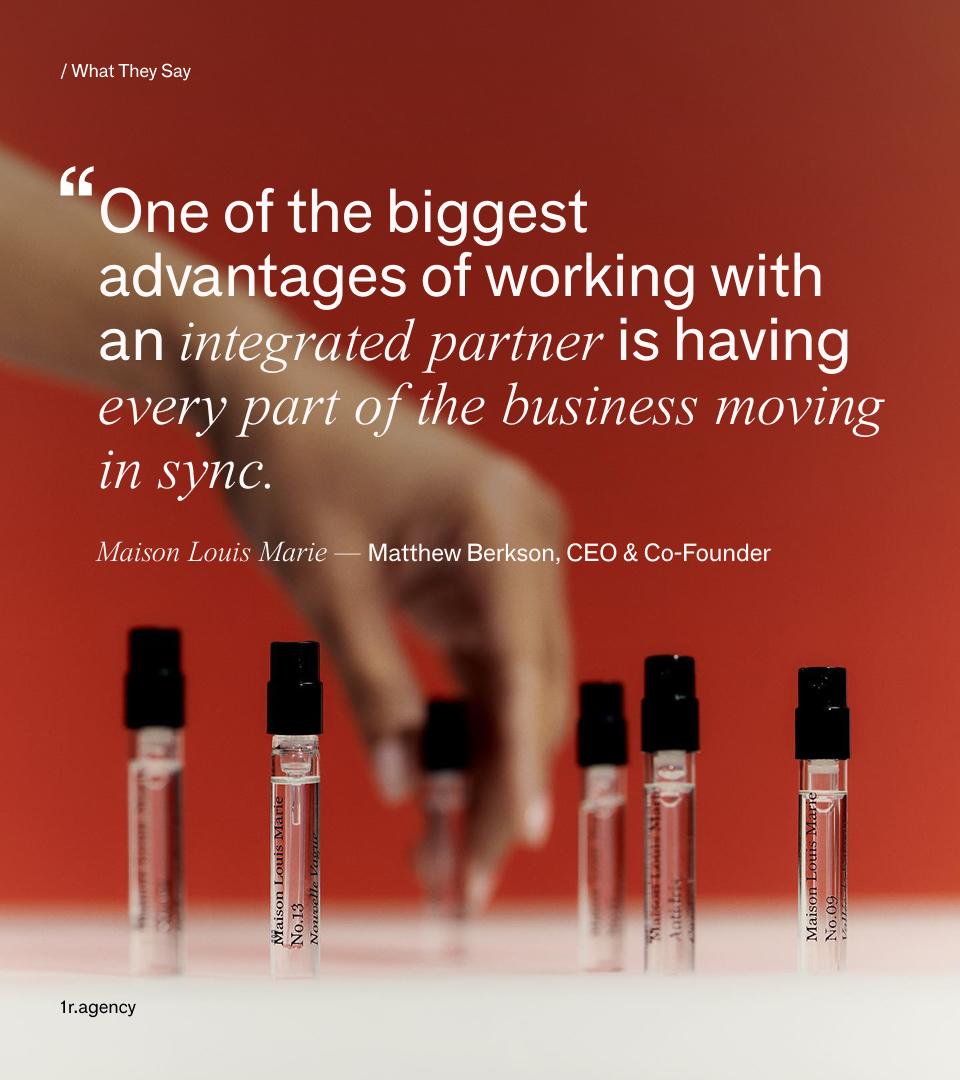
Why More Ecommerce Brands Are Replacing Multiple Agencies With Strategic Commerce Partners
The operational shift happening across modern ecommerce teams as brands prioritize alignment, efficiency, and connected growth.