Why More Ecommerce Brands Are Replacing Multiple Agencies With Strategic Commerce Partners
Nobody joins an ecommerce brand hoping to become a full-time agency project manager. But somehow it happens all the time. What usually starts as a smart, well-intentioned decision slowly turns into a complicated operational mess. A brand hires a paid media agency to scale acquisition, an email and SMS partner to improve retention, a Shopify agency for development and UX updates, maybe an SEO team layered in later to help drive organic growth.
On paper, it all makes sense. Specialists for every area of the business. But eventually someone internally ends up sitting in the middle of all of it trying to make sure everything actually works together. They’re relaying context between teams, sitting in status calls, chasing timelines before launches, reconciling reporting across platforms, and trying to figure out why growth still feels harder than it should.
We see this constantly with growing ecommerce brands. And the tricky part is that nothing necessarily looks broken. Traffic is up. Campaigns are launching. SEO rankings are improving. The site looks polished. Email engagement is healthy. Every partner has reporting that proves their channel is performing. But the business still feels like it’s pushing uphill.
When “Good Marketing” Still Doesn’t Create Momentum
One of the biggest shifts happening in ecommerce right now is that growth no longer happens in isolated channels. Paid media impacts conversion efficiency. Shopify UX affects acquisition performance. Creative influences retention. SEO shapes traffic quality. Lifecycle marketing impacts customer lifetime value. The customer experiences all of it as one brand journey, whether internal teams are structured that way or not.
But operationally, many ecommerce brands are still managing growth across disconnected agencies and separate workflows. That’s where things start slipping. The paid ad sets one expectation, but the landing page only partially follows through. The website experience looks great visually, but conversion paths were never designed around an acquisition strategy. Lifecycle messaging shows up later, sounding disconnected from the customer’s original entry point.
Individually, none of these issues seems massive. Together, they quietly slow growth down. And over time, brands often respond by adding more complexity. More agencies. More meetings. More tools. More reporting dashboards. More layers of communication. But more moving pieces rarely create better alignment. Usually, they just create more friction.
The Operational Cost Nobody Talks About
The real cost of fragmented ecommerce marketing usually isn’t visible in a dashboard. It shows up operationally. Internal teams become responsible for connecting the acquisition strategy to the retention strategy. They become the bridge between paid media, website development, SEO, analytics, creative, and lifecycle marketing. A huge amount of energy is spent translating priorities between vendors instead of focusing on actual business growth.
In other words, the brand becomes the integration layer. Or more realistically, someone on the marketing team becomes the person following up in Slack for the third time trying to figure out why the homepage update still isn’t live before tomorrow’s campaign launch. That’s not really a scalable operating model. And honestly, most of the time, the agencies themselves are not the problem. Many are very good at what they do individually. The problem is that nobody owns the connective tissue between all of it. That’s usually the missing piece.
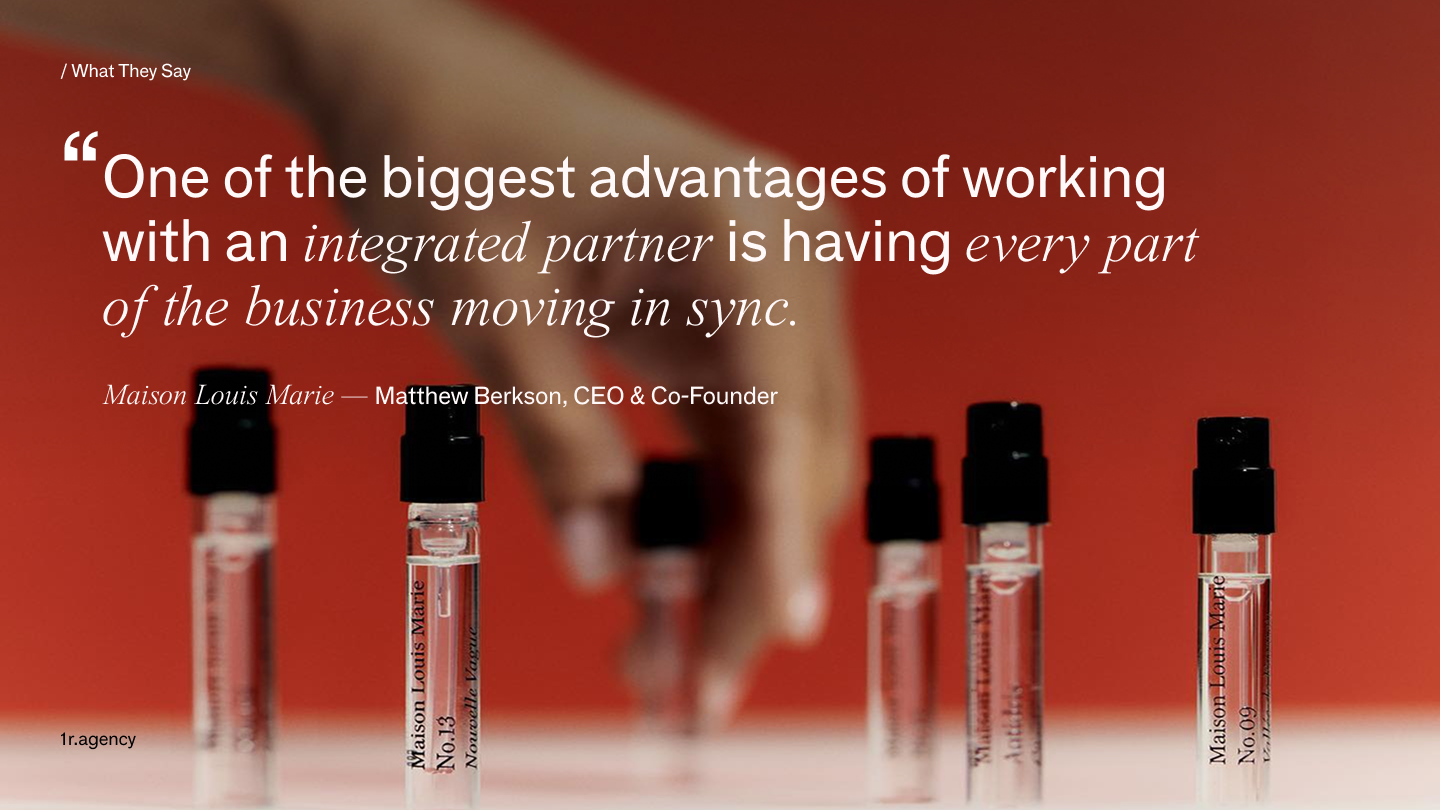
One of our clients at Maison Louis Marie said it best:
“One of the biggest advantages of working with an integrated partner is having every part of the business moving in sync. From paid media and website development to creative, email marketing, and SEO, every channel is approached with the same strategic and brand perspective. That level of alignment creates a more cohesive customer experience, streamlines execution internally, and ultimately allows us to focus more deeply on long-term brand growth.” – Matthew Berkson, CEO & Co-Founder, Maison Louis Marie
Honestly, that’s the unlock most brands are actually looking for.Because once acquisition, conversion, retention, creative, and customer experience are aligned under one strategy, the business starts operating differently. Teams move faster. Reporting becomes clearer. Customer journeys feel more intentional. Growth becomes easier to scale because momentum is finally building instead of constantly restarting.
Why Brands Are Consolidating Around Strategic Commerce Partners
This is exactly why more ecommerce brands are moving away from managing multiple disconnected agencies and looking for strategic commerce partners instead. Not just vendors who execute individual tasks, but teams that understand how the entire revenue system works together and are accountable to business performance, not just channel metrics.
At 1r Agency, that’s how we approach ecommerce growth. We don’t operate as a collection of disconnected services. We operate as a commerce system tied directly to revenue outcomes. Paid media, website development, lifecycle marketing, SEO, CRO, analytics, and creative are all approached as interconnected parts of the same growth engine. Because that’s how modern ecommerce actually works now.
The e-commerce brands scaling most efficiently today usually are not the ones doing the most. They’re the ones operating with stronger alignment, faster execution, clearer decision-making, and better continuity across the customer journey. Less fragmentation. Less operational chaos. Less time spent relaying context between vendors. More momentum. Better customer experiences. More efficient growth. That’s the shift we’re seeing across ecommerce right now. And increasingly, it’s what brands are looking for from their agency partners too.
If this sounds familiar, our team would be happy to chat. Reach out at hello@1r.agency.
Related News
See More
How to Choose the Right Shopify Design Agency for Your Brand
A practical guide to evaluating Shopify agencies based on performance, UX, scalability, and ecommerce growth strategy.

Building Hidden Crown for Growth
How 1r’s Design & Build SEO Approach Elevated Site Performance

The 3-2-1s of DTC Success for 2025
Read on to learn what winning DTC brands are doing to drive revenue.

How SkinLocal Connected In-Clinic & Online Experiences with Email Marketing
Learn how 1r Agency helped bridge the gap.
1r Agency Featured in BeautyMatter
1r Agency has been part of e-commerce's evolution from bold experiment to business essential—and now, we're sharing our expertise with you.